Theo Jansen, a kinetic artist and engineer from the Netherlands, has seemingly created a new life form. Although no real significance to the current studio project I decided to post this video after hearing from a co-worker from the office I worked at this summer. Prepare to be amazed.
Sunday, September 20, 2009

Saturday, September 19, 2009
Map(in) UNAM
The third assignment associated with this project has to do with utilizing visual information to demonstrate "real physical and phenomenological conditions" to a viewer through mapping of the UNAM campus. These maps, will not be your typical maps though, their abstraction and understanding are all based upon an idea of translation (your interpretation and understanding of "time, space, and experience".

Searching the web, I came across several concepts of mapping that were new to me - that I was interested in exploring for this project once I decide upon an area of campus to place focus and emphasis on/within. The first concept, as seen to the right, is an acoustical map, which measures the decibal level of sound throughout a given area.

The second concept, right, is a map of New York
City and its population density during the day vs. the night.
Other potential studies are seen below such as shadow mapping, left, and types of organization, right.


Searching the web, I came across several concepts of mapping that were new to me - that I was interested in exploring for this project once I decide upon an area of campus to place focus and emphasis on/within. The first concept, as seen to the right, is an acoustical map, which measures the decibal level of sound throughout a given area.

The second concept, right, is a map of New York
City and its population density during the day vs. the night.
Other potential studies are seen below such as shadow mapping, left, and types of organization, right.


Boîte-en-Valise
 As I had said, in the last blog, my pursuits went towards developing this idea of a morphological system of floor plates that created space within the library's shell. The model seen to the right, shows in rough scale, the project as an enclosed volume.
 The intention, as was almost impossible to portray in image, was based off a metaphor that tectonic plate movement below the surface of UNAM's campus was producing this effect. That the library itself was harnessing the energy (which can also be very symbolic to the power that books held within have) and it was being absorbed by the floor plates of the building. The plates were built tight with the model "shell" so that when the walls were pulled off as a whole the building within seemed to expand out of compression from within. Dynamic spaces were created between floors through this interconnected (in areas) and disconnected circulation flow that would occur within the building. Support columns would pierce through the floors to give support as necessary but few would remain in a strictly vertical manner - diagonals and slants to emphasis a kinetic morphing of the interior was applied here.


 The building arises out of a volcanic, turbulant landscape, stretches upwards releasing this energy until it is resolved at the roofline with the plates folding over one another to finish the volume. I did feel that the concept allowed/wants future growth of the library - potential for this idea to keep expanding - that its power cannot be harnessed by the walls of man, the mind (influenced and educated by the book) is the most powerful weapon. The building was spray painted a mix of lime green and red to symbolize that these plates are even absorbing the color of the facades on the exterior as they dissolve this energy rising from the ground.
Sunday, September 13, 2009
Inside the box
The second assignment for the UNAM Biblioteca project has focused on taking the volume containing the library stacks and imagine it as a "container" or cover if you will for the building. Just as a book cannot be judged by its cover, neither can a building. The assignment was to take this understanding graphically that can be seen in the buildings facade and interpret what "potentially happens inside the volume: not necessarily what exists...but what could exist within it.
 My interpretation of O'Gorman's facades above is that the four "containing" walls of the building are a harnessing power over the architectural elements (floors, walls, etc) on the interior and the intellectual elements (books, students, etc). This brought me to develop three conceptual model of the space that is found beyond the walls of the exterior.
The concept of all three models, made so far, is that the building is a shell - harnessing the power(s) from within the building as its knowledge is waiting to be released out.


The first model uses flat floor slabs with protruding and piercing structural elements to be contained within the mural walls of the library. I found this version to be in a very static state and that it was not clearly portraying my concept of this "explosion" of elements that would be found if the walls lifted away.


The second model (above) uses the actual floor plates to create the kinetic motion within the library. Each slab element is in "motion", moving throughout the spaces of the library generating volumes through their penetrations and enclosures. This model was a bit extreme and a little less functional for the programmatic requirements of a library space.
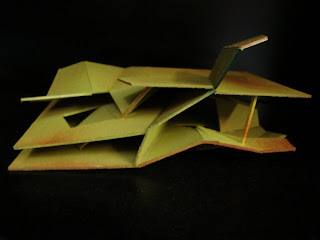

The third model (above) incorporates a blend of the two previous models to create something of a
morphological model in transition between static floor slabs and kinetic moving plates. It exemplifies my concept to its best ability at this point in time. Still much work to be done, but we're getting there...
 My interpretation of O'Gorman's facades above is that the four "containing" walls of the building are a harnessing power over the architectural elements (floors, walls, etc) on the interior and the intellectual elements (books, students, etc). This brought me to develop three conceptual model of the space that is found beyond the walls of the exterior.
The concept of all three models, made so far, is that the building is a shell - harnessing the power(s) from within the building as its knowledge is waiting to be released out.


The first model uses flat floor slabs with protruding and piercing structural elements to be contained within the mural walls of the library. I found this version to be in a very static state and that it was not clearly portraying my concept of this "explosion" of elements that would be found if the walls lifted away.


The second model (above) uses the actual floor plates to create the kinetic motion within the library. Each slab element is in "motion", moving throughout the spaces of the library generating volumes through their penetrations and enclosures. This model was a bit extreme and a little less functional for the programmatic requirements of a library space.


The third model (above) incorporates a blend of the two previous models to create something of a
morphological model in transition between static floor slabs and kinetic moving plates. It exemplifies my concept to its best ability at this point in time. Still much work to be done, but we're getting there...
Thursday, September 10, 2009
Final Critique :. Book of Traveler's Tales


The final review for the "Limits of Books Assignment" was set up with the intention of presenting each of our books to the critics as if they were a group of children who we read our stories to as if we were teachers of a kindergarten class. Being a giant map of sorts, I decided that my book would best be presented if I sat on the carpeted floor of the review room and read my book from there.
I explained the concept behind the book to be something as follows; After pulling the book from its worn crimson case (take careful notice of how the book looks when removed, above left), it reveals a map telling great tales from travels of old. As you begin your journey, the book unfolds to reveal your next destination along the route while simultaneously presenting the next tale to be encountered.


After "reading" the book (through explanation of a journey since they are very few words to the book) I pulled out the secret compartment built within the model (picture to come later) which was full of treasures and useful tools from every individual's "trip" that they have taken through the book. Matches, money, and a utility tool where among several of the items that spilled out onto the floor to accompany the next readers travels. Once you have finished a reading you are required to place an item in the secret compartment for the next reader as well as to fold the book up for another traveler to uncover its hidden tales. There is no set manner for which to put this book back in its case, just as a map gets stored in the glovebox so does this book on the shelf.
Readers themselves, through the way they fold the book, leave a piece of themselves behind - whether "their" folded version of the story is read or not is of no significance. Rather the constant folding/refolding allows a seemingly limitless number of stories (I am sure mathematically I could figure out how many there truly are but the beauty lies in there being minimal text - I left the books story to be left to the imagination of the reader - thereby creating no two stories alike!) A person receiving the book is only bound by its cover.


The book was put away, back into the case, in the manner above. Remember how I told you to pay attention to the way it was put away the first time, well if you see now, its folded a completely different way than it was when it was read last...and the story begins again.
The
Thursday, September 3, 2009
Book of Traveler's Tales Scheme
Being faced with Peter Greenburg's idea of "Prospero's Books", I chose A Book of Traveler's Tales. Let me begin by giving the preface for the book before I get back to the idea of my scheme.
"This is a book that is much damaged, as though used a great deal by children who have treasured it. The scratched and rubbed crimson leather covers, once inlaid with a figurative gold design, are now so worn that the pattern is ambiguous and a fit subject for much speculation. It contains those marvels that travelers talk of and are not believed. 'Men whose heads stood in their breasts,' bearded women, a rain of frogs, cities of purple ice, singing camels, Siamese twins', 'mountaineers dew-lapped like bulls'. It is full of illustrations and has little text."
When faced with the challenge of creating a book of traveler's tales I decided to approach it, as I stated in my last blog, like a map from the glovebox. The multitude of folds lead to uncovering of treasure, hidden wonder, and exploration of the land.
 To the left, you can see the concept in typical book form, but the idea was that this book would unfold to create a series of endless destinations and unfolding mysteries/tales/etc as you unfolded the creases of its pages.
Below, you can see the continuous unfolding that would happen upon the journey that begins upon opening the book. I am thinking that another more modern map might accompany the other side and that when it is folded by a person who is "new" to the book they will fold it differently than the last reader. Thus leaving a whole new adventure for the next in line!

"This is a book that is much damaged, as though used a great deal by children who have treasured it. The scratched and rubbed crimson leather covers, once inlaid with a figurative gold design, are now so worn that the pattern is ambiguous and a fit subject for much speculation. It contains those marvels that travelers talk of and are not believed. 'Men whose heads stood in their breasts,' bearded women, a rain of frogs, cities of purple ice, singing camels, Siamese twins', 'mountaineers dew-lapped like bulls'. It is full of illustrations and has little text."
When faced with the challenge of creating a book of traveler's tales I decided to approach it, as I stated in my last blog, like a map from the glovebox. The multitude of folds lead to uncovering of treasure, hidden wonder, and exploration of the land.
 To the left, you can see the concept in typical book form, but the idea was that this book would unfold to create a series of endless destinations and unfolding mysteries/tales/etc as you unfolded the creases of its pages.
Below, you can see the continuous unfolding that would happen upon the journey that begins upon opening the book. I am thinking that another more modern map might accompany the other side and that when it is folded by a person who is "new" to the book they will fold it differently than the last reader. Thus leaving a whole new adventure for the next in line!

Tuesday, September 1, 2009
How do you fold this thing?

Ever been on a trip and unfold the map from the car glove compartment, follow the streets with the tip of your finger in the passenger seat while the lost driver accepts directions in an angry manner? If yes, then think about how fun it was to try and put that map back in the glove box, no? Folding it this way and that along the pre-defined creases of the page that NEVER....EVER seems to be put away the way it came out of the package. Frustrated....why?
If you've never been in this predicament before than you either don't travel, are really good with directions anywhere (uh huh...), or have the lifesaving GPS system. But if you have, frustration need not be an issue. Rather than thinking about the map as an ignorant piece of paper that just wants you to get angry in the confines of your small sedan - think about it as an adventure in itself.
This is the basis for my book concept. If your map was to always fold correctly, then you were most likely never utilizing it for more adventurous trips, but most likely the same trip each time. But, if the map doesn't fold the "right" way then unfolding it for the next trip reveals aspects of the topography that may have gone unnoticed. The book I am working on combines this idea with a book of traveler's tales (rain of frogs, bigfoot, etc). As you unfold the map you are presented with tales from various portions of the map in series of unfolding panels. These panels will, most likely, never be arranged the same way by a reader - thereby giving each reader a new experience when they pull the book off the shelf.
Subscribe to:
Posts (Atom)